

How Artificial Intelligence Can Support and Enhance – or Destroy – Critical Thinking

In this new era since Google and AI, we are inundated by information overload, polarized arguments, and computer generated realities. Critical Thinking has never been more consequential or more difficult to cultivate.
This article examines how AI tools can legitimately support and enhance Critical Thinking when used purposefully; however, careless or passive AI use can quietly erode the very capacities it appears to support.
Drawing on cognitive psychology, argumentation theory, and media studies, it offers a framework for integrating AI as a scaffold rather than a substitute for rigorous intellectual practice.
What Critical Thinking Requires
Before asking what AI can contribute, we need to be precise about what Critical Thinking actually demands.
Peter Facione’s landmark Delphi Report, commissioned by the American Philosophical Association, defined critical thinking as “purposeful, self-regulatory judgment which results in interpretation, analysis, evaluation, and inference” (Facione, 1990, p. 2).
Richard Paul and Linda Elder refine this further, emphasizing that the skilled thinker must not only reason well but must actively monitor and correct their own reasoning process, what they term “intellectual self-discipline” (Paul & Elder, 2022).
At its core, Critical Thinking is an effort with the ability to be aware of your own thinking process, then monitoring and evaluating that activity. You must be able to tolerate uncertainty, seek alternative or more accurate evidence, and revise conclusions where warranted. It is precisely because these tasks are demanding that AI assistance can be genuinely valuable. BUT, AI cannot do this without the proper instructions!
Five Ways AI Can Support Critical Thinking
1. Generating Counterarguments and Challenging Assumptions
One of the most powerful applications of AI in Critical Thinking is using it as our devil’s advocate.
We all tend to generate arguments that favor our pre-existing positions. These are often not even apparent to us. This is among the most well documented reasoning errors in the literature (Stanovich, West, & Toplak, 2016). We can explicitly prompt AI tools to produce the strongest counterarguments to a position the thinker already holds (*See sample prompts at the end of this article).
For example, a graduate student drafting a policy argument can ask an AI to *”Provide the most rigorous objections to this position from opposing perspectives.” (* See 33 sample prompts at the end of Chapter 9 in my book, Succe$$ Through Critical Thinking). The result is not an answer to accept uncritically, but a list of challenges to examine, refute, or incorporate. This mirrors the Steelman Technique, constructing a powerful version of an opposing or different view which is the cornerstone of rigorous academic arguments.
Key Model: Steelman Technique: deliberately constructing the strongest version of an opposing argument before responding, using AI to surface objections the thinker may not have considered.
2. Scaffolding Argument Analysis
AI tools excel at helping users deconstruct complex topics into their logical structure and then build a new scaffold structure. A student presented with a dense academic document or a group working with a policy or strategy can use AI to help identify the main claim, supporting premises, implicit or hidden assumptions, and potential weaknesses. In effect, it helps apply Toulmin’s argument and thinking model as a first-pass analytical level (Toulmin, 2003).
This is particularly valuable for those who have not yet understood and incorporated formal arguments into analyses and Critical Thinking. Research on examples and scaffolding efforts in education consistently shows that structured support when learning these skills reduces “cognitive overload,” that is, when there is too much information to effectively process. This support can accelerate the user’s development of independent competence (Sweller, 2011). AI-assisted argument mapping serves exactly this function.
3. Supporting Source Evaluation and Lateral Reading
The SIFT method guides us to Stop,Investigate the source, Find better coverage, and Trace claims to their source. SIFT is one of the leading frameworks for digital information literacy (Caulfield, 2017) while WOTS-UP? is a new framework incorporating SIFT concepts. AI tools can support both of these – and other – thinking models.
AI can provide background on any known biases of a publication, website, or organization, sources for their credibility, funding sources with potential bias, help identify whether a claim by one of these sources has been independently corroborated, and flag when a widely shared statistic cannot be traced to a primary source.
Wineburg and McGrew’s (2019) research on lateral reading demonstrates that professional fact-checkers habitually leave a source immediately to find out what others say about it, rather than reading deeply within it. AI can accelerate this process, serving as a rapid research assistant that helps users triangulate claims across multiple independent sources.
Key Models:
The SIFT Method (Caulfield, 2017): Stop, Investigate the source, Find better coverage, and Trace claims to their origin. AI can support each step at high speed.
WOTS-UP?: a mnemonic thinking model that is Very Simple, Easy to Teach, Easy to Remember, and Easy to Use. Studies have shown, mnemonics combined with visual supports aid memory retention. WOTS-UP? uses videos and graphics to support learning and using it whether employees, students, groups, or leaders for Critical Thinking. Here’s a graphic briefly describing the full process of WOTS-UP? CARROT.
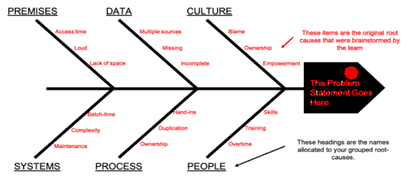
FISHBONE Analysis: often used for manufacturing, engineering, or technical problem analysis (see discussion of this model in my new book, Succe$$ Through Critical Thinking). Here’s a quick overview…
4. Facilitating Socratic Dialogue
Perhaps the most underutilized application of AI in education is using it to create a Socratic dialogue. This is not to provide answers, but to ask probing Socratic-style questions. When prompted appropriately (e.g., *”Ask me Socratic questions about my argument rather than evaluating it”), AI can function as an interactive thinking partner, pressing the user to clarify terms, examine hidden or biased assumptions, and force the user to defend their premises.
This aligns with Paul and Elder’s intellectual standards framework (2020), which holds that clarity, precision, and depth of reasoning are developed through disciplined questioning rather than just absorbing and using data and information. The conversational, iterative nature of AI dialogue tools makes them uniquely suited to this pedagogical use.
5. Making Cognitive Biases Visible
AI tools can be used to audit our reasoning for common cognitive biases In a Cognitive Bias we create our own subjective reality based on our existing perceptions and prejudices). A decision-maker preparing a business case, or a researcher drafting a literature review, could share their draft with an AI and ask: *”What confirmation bias might be present in how I’ve framed this? What evidence might I be underweighting?” As demonstrated in Chapter 9 of my book Suce$$ Through Critical Thinking, WOTS-UP? encourages this in analyzing Unknowns and Potential Issues.
This functions as an external version of Argyris’s Ladder of Inference (1990) where users make their scaffolding rungs from raw data to conclusions open to renewed scrutiny.
Kahneman’s dual-process theory (2011) proposes that System 1 thinking is fast, intuitive, and bias-prone, while System 2 is slow, deliberate, and corrective. An AI-assisted review can function as a trigger for engaging with System 2 thinking, prompting the kind of deliberate re-examination that busy professionals and students often skip (i.e., Heuristics).
How NOT to Use AI in Critical Thinking
Given all the above, it may be tempting to conclude that more AI involvement is always better.
This conclusion is wrong!
The misuse of AI in Critical Thinking can be misleading and is a serious concern that deserves explicit attention.
1. Error – Outsourcing Judgment
The most dangerous misuse of AI is using it to replace reasoning rather than support it.
When a user asks an AI “What should I think about this argument?” and accepts the response without independent evaluation, they have not engaged in Critical Thinking. They have delegated it to AI.
This mirrors the problem that Zagzebski (1996) identifies with deference to authority: when we simply adopt another agent’s conclusions without examining the reasoning behind them, we forfeit our intellectual autonomy. We ignore the nature, origin, and limits of human knowledge.
Similar to WOTS-UP? Unknowns, Potential issues and the question mark (?) questions about what we can and cannot know, how we acquired our knowledge, and the justification of that knowledge and our beliefs. These problems often involve skepticism about the certainty and scope of our knowledge.
This is particularly insidious because AI responses are fluent, confident, and delivered authoritatively. Research on “Automation Bias” (i.e., AI and our tendency to over-rely on automated systems) documents that people frequently fail to question system outputs even when those outputs are demonstrably wrong (Parasuraman & Manzey, 2010). Users and those participating in a Critical Thinking process must be trained to treat AI outputs as a starting point for analysis, not an endpoint.
Warning: Accepting AI outputs without independent evaluation is not Critical Thinking. It is a delegation. Automation Bias makes this trap especially easy to fall into (Parasuraman & Manzey, 2010).
2. Error – Using AI to Generate Arguments You Haven’t Thought Through
Using AI to produce arguments for a position one has not personally examined is an exercise in intellectual laziness masquerading as productivity.
If a person or group uses AI to generate a thesis statement, supporting claims, and counter arguments, they have bypassed the very cognitive work that produces genuine understanding. Worse, they are likely to be unable to defend or extend those arguments when challenged, revealing the hollow foundation of the work. The goal of WOTS-UP? CARROT is to help guide a person or group through the full process.
This connects to Dweck’s (2006) research on growth mindset: intellectual capacity is built through productive struggle, not through avoiding it. AI that removes difficulty removes that growth.
3. Error – Mistaking AI Confidence for Epistemic Reliability
Epistemic Reliability is research supported and refers to the concept that a belief is justified or constitutes knowledge if it is formed through a reliable process that tends to produce true beliefs. All these models – including WOTS-UP? – because they all provide a logical process.
Much like ourselves, AI language models do not know what they do not know. They generate plausible-sounding text based on pattern recognition, not verified knowledge retrieval. They can produce citations that do not exist, statistics that are fabricated, and logical inferences that are subtly invalid, all expressed with the same confident fluency as any accurate statements. Treating AI output as justified knowledge equivalent to peer-reviewed research is an error that no critical thinker should make.
AI generated “knowledge” and source references must be fact checked.
Levitin (2016) warns that the most dangerous misinformation is not obviously wrong, it is plausible enough to pass casual inspection. AI errors fall squarely into this category. Every factual claim from an AI source must be independently verified before it is used.
4. Error – Allowing AI to Narrow Rather Than Expand Thinking
Finally, AI tools reflect the biases, omissions, and concepts (right or wrong) present in the training data used. Relying heavily on a single AI tool as a research and reasoning partner can paradoxically narrow one’s perspective rather than broaden it. It’s the digital equivalent of reading only one newspaper or relying on a single set of facts. Sunstein (2017) has documented the dangers of these information environments that filter out challenges and dissent. AI tools can create a similar effect at the level of individual reasoning.
Critical Thinking AI Prompts to Avoid
Worst AI Prompts to Avoid in Critical Thinking
These fifteen prompts – and any similar to them – outsource thinking to AI, create lazy intellectual thinking rigor, or reinforce existing beliefs without examination.
Outsourcing Your Conclusions
- “What should I think about this [question / position / strategy].”
- “What’s the best answer here?” (without engaging with the reasoning yourself)
- “Summarize both sides.” (so I don’t have to do any research or read about it)]
- “Which [question / position / strategy / conclusion / recommendation] is most correct on this issue?”
Confirmation-Seeking
- “Explain why [my existing belief] is correct.”
- “Give me arguments that support my position.”
- “Tell me why people who disagree with me are wrong.”
- “Prove that my [question / position / strategy / conclusions / recommendations] are good or bad.”
Intellectually Passive
- “Write an analysis for me.”
- “Read this article and tell me what to think of it.”
- “What is the best answer?” (I don’t need the explanation)
- “Do you agree with me?” (seeking validation rather than examination)
Vague or Closed
- “Is this true?” (without sharing your own tentative reasoning)
- “Am I right?” (same problem)
- “Explain this in simple terms” [OK for learning facts, but weak for building Critical Thinking skills]
********************************
Artificial intelligence is neither a replacement for Critical Thinking nor its enemy.
It is a tool, albeit a powerful one growing in power each week. It can, be imperfect, and entirely dependent on the wisdom or “AI prompts” of the person directing it. Perhaps more productive for Critical Thinking, it can generate counter arguments, conduct scaffold analysis, facilitate Socratic inquiry, and audit potential biases.
AI can meaningfully enhance the quality of human reasoning and our Critical Thinking. Used as a substitute for intellectual effort and research rigor, however, it can generate unverified claims and generate borrowed or specious arguments. It then undermines the very capacities it appears to support.
The Critical Thinker’s task, as it has always been, is to reason well. WOTS-UP? CARROT can guide the process, but cannot substitute for sound facts and sources. AI can make that task easier, richer, and more rigorous,,but only if the thinker remains firmly in command.
AI should serve the thinker.
The moment the thinker serves the AI,
Critical Thinking ends or is misleading.
************************************************************************************
References for a Deep Dive of this Article
Argyris, C. (1990). Overcoming organizational defenses: Facilitating organizational learning. Allyn & Bacon.
Caulfield, M. (2017). Web literacy for student fact-checkers. Pressbooks. https://webliteracy.pressbooks.com
Dweck, C. S. (2006). Mindset: The new psychology of success. Random House.
Facione, P. A. (1990). Critical thinking: A statement of expert consensus for purposes of educational assessment and instruction. American Philosophical Association.
Kahneman, D. (2011). Thinking, fast and slow. Farrar, Straus and Giroux.
Levitin, D. J. (2016). A field guide to lies: Critical thinking in the information age. Dutton.
Parasuraman, R., & Manzey, D. H. (2010). Complacency and bias in human use of automation: An attentional integration. Human Factors, 52(3), 381–410. https://doi.org/10.1177/0018720810376055
Paul, R., & Elder, L. (2022). Critical thinking: Tools for taking charge of your learning and your life (4th ed.). The Foundation for Critical Thinking.
Stanovich, K. E., West, R. F., & Toplak, M. E. (2016). The rationality quotient: Toward a test of rational thinking. MIT Press.
Sunstein, C. R. (2017). #Republic: Divided democracy in the age of social media. Princeton University Press.
Sweller, J. (2011). Cognitive load theory. In J. P. Mestre & B. H. Ross (Eds.), The psychology of learning and motivation (Vol. 55, pp. 37–76). Academic Press.
Toulmin, S. E. (2003). The uses of argument (updated ed.). Cambridge University Press. (Original work published 1958)
 Français
  English